

Historic Will: Lizzie Borden’s Inheritance
Today, I bring you the next installment in my series on historic and celebrity wills. In honor of Halloween and the spooky season, and at the suggestion of my friend and colleague, Rachel Schromen, I am focusing on that infamous, alleged murderer: Lizzie Borden.
Many of you are familiar with her story. Lizzie Andrew Borden, born July 19, 1960, grew up in Massachusetts as the youngest of three daughters (one of her sisters died young). A few years after her mother’s death, her father, Andrew Jackson Borden, married her stepmother, Abby Gray.
As an adult, both Lizzie and her older sister, Emma Borden, lived with her father and stepmother. They also had a live-in maid, Bridget Sullivan. For some weeks prior to the murders, tensions had been growing in the Borden household. On Thursday, August 4th, 1892, Emma was out of the house. After breakfast, Andrew and their houseguest left the property. Between 9am and 10:30am, Abby went up to the guest room on the second floor and was murdered there. Around 10:30am-11am, Andrew returned home and lay down on the sofa for a nap. At 11:10am-11:15am Lizzie called to the maid that she had found Andrew murdered and sent the maid to request a physician come to the home. The physician pronounced both victims dead.
Over the course of the inquest and investigation, authorities came to believe that Lizzie Borden was guilty of the murders. In 1893, Lizzie was tried in a court of law and acquitted of the murders.
Although her father was not wealthy as a young man, Andrew Borden gained considerable wealth throughout his life—at the time of his death in 1892, his estate was valued at $300,000 (in today’s money, almost 11 million dollars). So: what happened to the money after his murder?
The short answer: Andrew and Abby had no wills, so Lizzie and her sister Emma split the money, with a settlement to Abby’s relatives.
The longer answer: Because Abby died first, the general assumption is that her assets would be legally owned by Andrew upon her death.
Note: the reason I say “general assumption” is because there are several things I do not know: (1) I do not know the nature of the property that Abby owned (which would make a difference in Andrew’s ability to inherit it, and (2) I do not know how any such property was titled (for example: in Abby’s name solely versus joint with Andrew versus tenancy-in-common versus another ownership). Both of these factors would have made a difference under Massachusetts law at the time.
In theory, then, if Abby’s assets all pass to Andrew, then upon Andrew’s subsequent death, his estate (now also including Abby’s property) devolves on his heirs. Andrew had two living children—Lizzie and Emma. Those children split his entire estate. And, of course, this appears to have been the result.
But Chris! What about the slayer statute?
Great question! For those who don’t know, a “slayer statute” is a statute that states, more or less, if you were involved in causing someone’s death, you don’t get to inherit from their assets. The language in slayer statutes can change across jurisdictions, but that’s the gist of it.
So in theory, if Lizzie whacked her dad and stepmom, she shouldn’t inherit from their estates. That’s justice! So why would Lizzie, an infamous (alleged) murderer, inherit?
Unfortunately, there are two problems with relying on the slayer statute here:
- Lizzie was acquitted, remember?
- Massachusetts didn’t have a slayer statute at the time! In fact, Massachusetts did not enact its slayer statute until 2003, some 111 years too late.
Even without a slayer statute, in theory someone could have sued Lizzie under common law rules; after all, it doesn’t seem just that Lizzie Borden would inherit, and the common law can sort out this problem. However, that would require someone with standing to actually want to sue. For example: Emma. That doesn’t appear to have happened in this case. Emma and Lizzie went on to purchase and live in a beautiful, elegant home together after the acquittal.
However, please do note that multiple sources tell us that Emma and Lizzie Borden made a settlement with Abby’s family. That indicates (to me) that someone in Abby’s family was willing to press a suit. To avoid this, the Borden sisters paid out a settlement, in an amount I was unable to discern.
Unlike her father, Lizzie Borden did make her own will to dispose of her nearly $1 million estate upon her death in 1927 (this figure is according to the New York Times of the day, although many other sources now put her net worth to closer to $250,000.00, or $6.2 million in today’s money). Also unlike her father: the ultimate beneficiaries of Lizzie’s estate are somewhat less interesting.
The final lessons of this tale:
- Thank goodness we have a slayer statute in Minnesota.
- Wills are generally a good idea.
- The fact of a settlement, without further information, is inherently interesting and telling.
- See number 1.
*Citations omitted. Please note that I am not a historian or a journalist. While I have done my best to verify the facts and information presented, please note that the information gathered to tell this story is typically obtained from secondary sources without a trained historian’s review or a news journalist’s source vetting. Please enjoy with that spirit in mind.
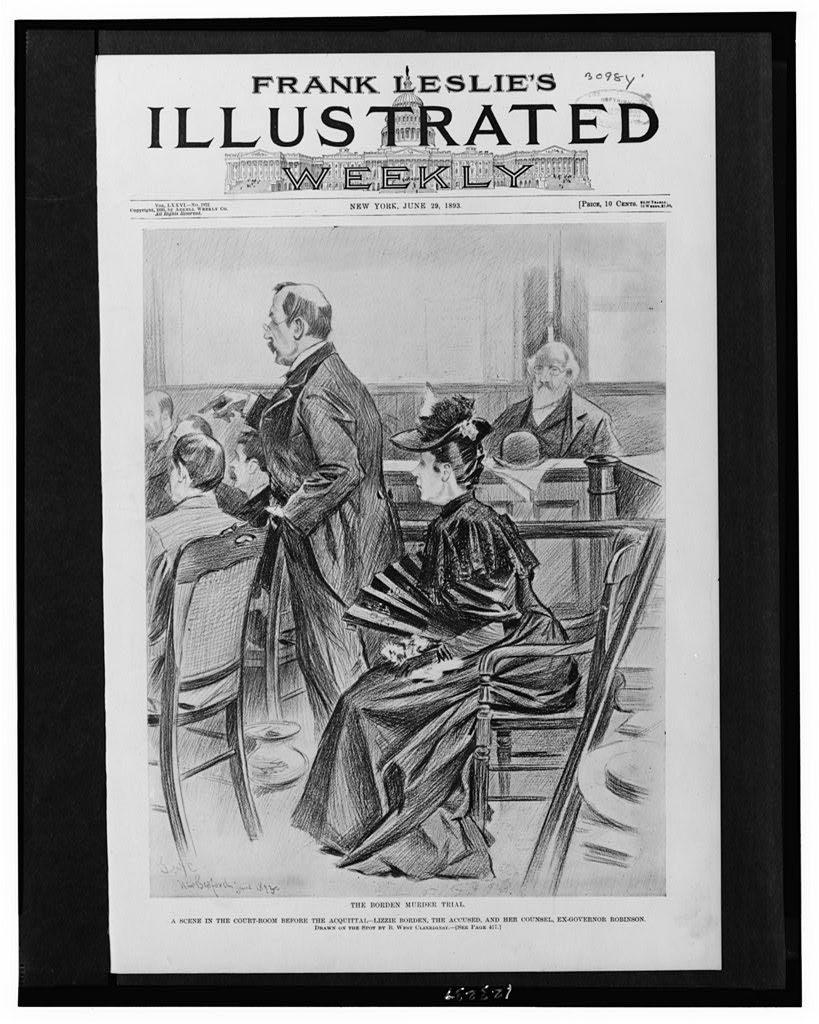
Image source: Clinedinst, B. West (Benjamin West), 1893. The Borden murder trial–A scene in the court-room before the acquittal – Lizzie Borden, the accused, and her counsel, Ex-Governor Robinson. Library of Congress Prints and Photographs Division. Call Number: Illus. in AP2.L52 1893 Case Y [P&P]. Accessed via https://www.loc.gov/pictures/item/99403183/
